
DEEP DIVE
UX Design
The Redesign
That Never Shipped
The wireframes were replaced. The navigation stayed. A short account of what actually protects your work when a project changes hands.
Company
KLAS Research
Year
2018 - 2020
Discipline
UX design, information architecture
The problem
Important things were invisible.
The navigation was the symptom.
By 2020 the KLAS website had a problem that was affecting both customers and internal teams. Important reports, key research, and high-value content were buried deep in the site with no clear path to the surface. Sales teams had quotas tied to specific content that visitors could not easily find. Healthcare professionals landing on the homepage had no immediate answer to the most basic question a new visitor asks: what is this and what can it do for me?
The navigation was built for desktop and had not kept pace with how people actually used the web. Chat, Best in KLAS, blogs, and search all needed to live at the top of every page where users expected to find them. The overall look of the site had grown dated and the feedback from customers and employees was consistent. This does not look like the research company we trust.



The work
Two layers of navigation and one clear question answered above the fold
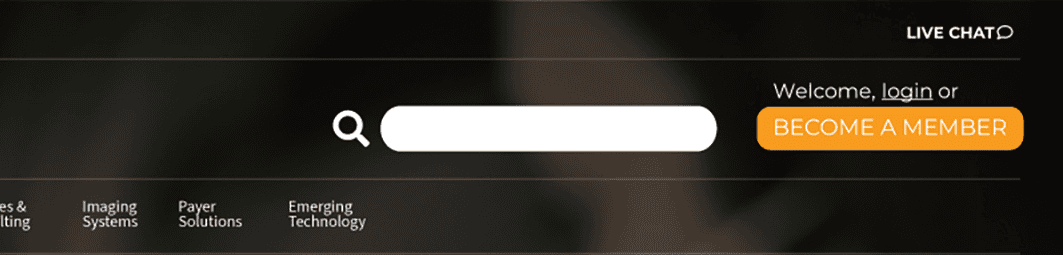
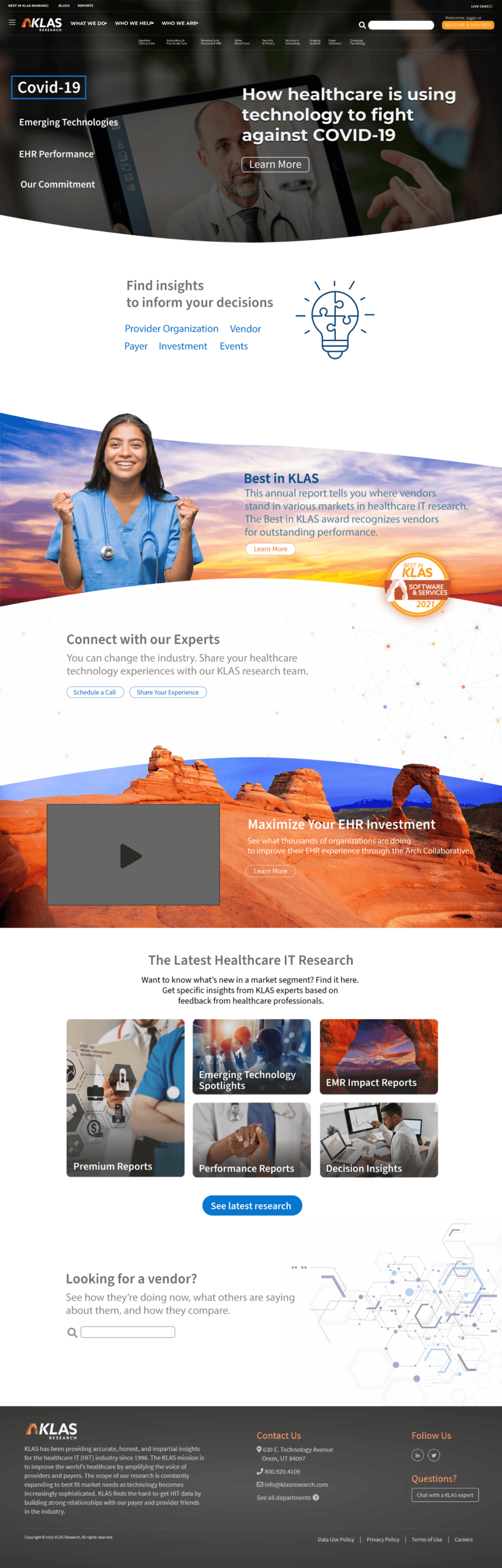
The redesign addressed the structure before the aesthetics. The navigation became two tiers. A utility bar at the top held the things power users reached for repeatedly, Best in KLAS rankings, blog, reports, and live chat. The main navigation below it held the market segment categories, Inpatient Clinical Care, Ambulatory, Revenue Cycle, Value Based Care, Security, Services, Imaging, Payer Solutions, all visible without a click, all immediately scannable.
Below the hero, the site answered the question every visitor was actually asking. A section titled "Find insights to inform your decisions" gave five clear entry points by audience type. Provider Organization. Vendor. Payer. Investment. Events. Five different people with five different needs could each find their lane without reading a word of body copy.
Key content came forward. Latest research surfaced in a grid. Best in KLAS was prominently anchored mid-page. A vendor search bar appeared without requiring navigation. Everything the previous site had buried was now reachable within one or two clicks from the homepage.
The approval
Marketing manager and a corporate consultant in the room. Both signed off.
The redesign was not a solo proposal. I worked directly with the marketing manager and a corporate consultant who had been brought in to evaluate the site's effectiveness. The new design was reviewed, discussed, and approved. Implementation began. The navigation went live. The site was halfway through build when I transitioned to the video studio full time.
A new UX designer was hired. They took the project in a different direction, simplifying the visual approach back toward the aesthetic of a previous site iteration. The overall redesign was replaced. The navigation structure I had built remained.
The outcome
The wireframes never shipped.
The navigation did.
The high fidelity wireframes I produced for the full homepage redesign were never implemented as designed. The visual direction was redirected by the incoming designer. What survived was the two-tier navigation system, the utility bar at the top and the market segment navigation below it. That structure stayed in place because it worked. Users were already oriented to it.
The design was sound. The timing was not.

What I learned
Approved does not mean permanent
The lesson from this project is not about design quality. The wireframes were strong, the approval was real, and the structural decisions held up even after the visual layer was replaced. The lesson is about organizational reality. When a project transitions between designers mid-build, the incoming designer has every incentive to put their own mark on it. What protects your work in that situation is not the approval. It is how deeply the structural decisions have been embedded before the handoff happens.
If I were doing this again I would have pushed harder to complete the build before stepping away. The navigation survived because it was already live. The rest of the redesign did not survive because it was still in wireframes. That distinction taught me more about the relationship between design and organizational momentum than any completed project could have.